Way back in those days before we invaded a country for no other reason than wicked greed…well that’s not accurate. We, as a country, have done that repeatedly. Let me start over.
Long ago, late in year 2002, when the 2nd Bush administration was contemplating the invasion of Iraq a group of citizens up in Damariscotta, Maine formed a peace and justice effort called “Bridges for Peace”. Simply, the group met every Sunday for an hour on the bridge over the Damariscotta River which flows under Route 1A between Newcastle and Damariscotta. Over the next few weeks other bridges in Maine drew people on Sundays from noon to 1 P.M. to stand vigil. Some people brought signs protesting violence and war. Some people brought signs that supported peace and justice. Some signs were simple; cardboard with letters made with a sharpie, some signs were made of plywood attached to wooden stakes with letters of various paints. It was all very grassroots and people were energized, ready to stand and show displeasure with good intention and a high level of purpose and togetherness.
Little did we know that it was all for naught. The 2nd Bush administration was locked into a plan that had begun on the night of Bush’s inauguration in 2001 and gained support with the attack on the WTC and the Pentagon. No amount of talk or vigil would slow down, much less stop, the march toward the invasion of Iraq. Just the same there we were, frightened citizens forming into groups of comrades to face down our aggressor leaders, shame them into backing away from armed aggression.
A few people in the Boothbay Region got busy and we soon formed a basic group that we called Peace and Justice Boothbay. At the same time I had a made a new friend, Sigrid, from Annapolis, Maryland who was visiting for about six months. She was building a boat locally and I was giving her help in storing it inside my shop while she painted it and got it ready for the trip back to Maryland. It was Sigrid who had begun with a woman from Bristol, Gretchen, to stand on the bridge in Damariscotta to protest for peaceful solutions. Sigrid convinced me to begin a vigil effort down the peninsula in Boothbay. The only Bridge we had was the Southport Bridge over the gut.
So, in the fall of 2002 we began standing vigil on the Southport Bridge. At first there were only a few of us. In fact the first vigil we stood there were three of us; my son Sam who was ten years old, Hilary an artist, and me. We stood on the bridge, in the rain and the wind, and we felt varying levels of satisfaction that we were activist and doing good. Over the next few weeks we gathered more people. The bridge traffic was not heavy at all this time of year and the fact it was Sunday didn’t increase the numbers. Still we stood with signs because that was our bridge and our job was to stand on it rain or shine. We discovered after a while that the wind blowing through the gut could turn the hardiest of us to icicle. I think at the peak of our vigil efforts we had over a dozen people which is a good crowd considering the population of our community.
We did eventually lose people because of the conditions on the bridge. It was not comfortable at all to be out there in the weather with no shelter. I believe we stood weekly vigils for over a year on this bridge. A year later in late winter on the Southport Bridge was a miserable place to stand. Because there was so little traffic in winter we made a move to change locations to a more traveled bridge, the Donald E. Davey Bridge in Wiscasset. Moving to the Wiscasset Bridge wasn’t much better but we could take turns going into the nearby restaurant to get relief. People would come and go and I was stubbornly refusing to stop the vigil. We had news of eleven bridges in Maine being used for vigils but in a few years I think the only bridges left were the original two. The war began and after a while we all quit the vigils.
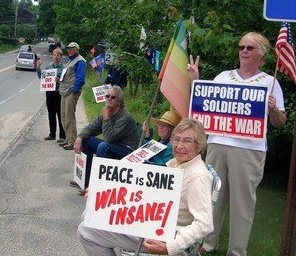
The spirit of activism remained. Sporadically the Boothbay group would stand vigil outside the Hannaford supermarket at the junction of routes 27 and 96 adjacent to the ‘small mall’. This was the location of the only traffic light in town so we did get a lot of exposure there. Peggy Voight was the person who headed this effort. We stood vigil during the warmer months only, during tourist season to get the most out of our efforts.
It’s been almost fourteen years since our first bridge vigil on Southport. We don’t stand anymore. Peggy is gone and the rest of us are a lot older. The wars continue.
One of the original vigil people wrote a sweet essay regarding our activism. It was written before the hostilities began in Iraq. I’ll post it right here for your enjoyment. Thank you, Nancy Atwell.
Sundays on the Bridge with George
By Nancie Atwell
I glanced up from the Sunday Times at the clock on the kitchen wall: 11:45. In the next room my husband began to pace; I knew he knew what time it was, too. Behind him, beyond the picture window, snow fell, so thick I couldn’t see our pond. I pretended to read the paper as I waited to see what Toby would do.
“I’m going,” he announced. “George hasn’t e-mailed, so it must be on.”
“I’ll get dressed and tell Anne,” I sighed. “Wait for us.” Half of me was relieved that someone—George, the organizer of the weekly vigils—had the strength of character to decide that snow wouldn’t stop us. The other half was reluctant, in the extreme. Even on a sunny afternoon, the wind off Townsend Gut cut like knives. This promised to be the longest, coldest hour yet.
The cold—bitter, frigid, unrelenting—was the first surprise about standing on the Southport Bridge, holding onto a tagboard sign for dear life as blasts of wind fought me for it. In theory the Bridges for Peace campaign against the invasion of Iraq was a brilliant tactic. The rivers, bays, and bridges of Maine are potent symbol of the connectedness of all living things and a powerful setting for demonstrating against war. In practice the Bridges for Peace movement depended on the hardiness of a band of anti-warriors who could remain upright on a Maine bridge for an hour every wintry Sunday and live to tell the tale. I learned not to leave the house at noon without gloves inside mittens, a scarf tied around my hat, and two coats over two sweaters.
The second surprise was the public response to the protests. I was knocked out by the number of Southport oldtimers who honked their horns, smiled, and waved at us as they drove over the bridge we’d lined with our bodies and signs. Each friendly gesture felt like someone had turned up the thermostat a notch. After every honker, we smiled and high-fived one another. “All right! Peace!”
But some of the responses scared me and worried me for my daughter. I made a point of wearing my Southport hat, so islanders could recognize that the folks on the bridge weren’t outside agitators from, say, Damariscotta. This didn’t prevent a lot of dirty looks, and it never stopped one of my neighbors from making a famous obscene gesture as he cruised by. One Sunday he slowed his truck way down, I hoped to read my latest tome of a sign, but instead locked eyes with me, mouthed the name of a body part, and shook his fist.
The previous Sunday, on another Maine bridge, an angry selectman had driven his car into the protestors, sending two of them to the hospital. Although nothing that ugly happened on Southport, I was relieved when one of my old Boothbay students, now a sheriff, took to parking his cruiser near the end of the bridge.
The signs we waved in front of passing cars ran the gamut: ban-the-bomb symbols, American flags, and all manner of written messages. My signs were ridiculous, but I didn’t care. On each one I presented, in large, careful block letters, my best argument to speeding vehicles about the injustice of this war (“50% OF IRAQIS ARE CHILDREN 15 AND YOUNGER”) and the need for a change in U.S. policy (“WIN WITHOUT WAR: SAY YES TO INSPECTIONS AND CONTAINMENT”). While I tried to engage Southport in a political debate at thirty mph, Toby carried the same, wind-battered sign week in and week out: “No War.”
Because of the constant cold, exposure to wind, and hum of apprehension, the hour on the bridge was the longest of my week. I passed it one minute at a time, anticipating the rumble of the snow tires of the next vehicle, waving my sign at it when it passed, and listening to my daughter as we took turns standing in front of each other as wind shields. Anne talked to me about her week, her classes and teachers, her friends, and her anguish about the impending invasion. Where were the other Annes? In all our Sundays on the bridge, no other teenager joined our group.
“Why not?” I asked her. “Don’t they know what’s going on in the world, talk about Iraq, understand that the U.N.—“
“I don’t know, Mom,” she cut me off. “I’m not the spokesperson for the youth of America. You could just as well ask why we’re even here. What is this accomplishing?”
I responded the only way I knew how, with another question. “What else can we do?” Any deed, any action, even putting my body on a bridge for an hour, felt better than seething in helpless rage over what my country was about to do.
And then it was 1:00. I said good-bye to George, jogged stiff-legged off the bridge, climbed into the car, and screamed with relief at being out of the wind. The Volvo warmed up by the time we reached the house, where I popped mugs of milk into the microwave for hot cocoa, and we slipped back into our Sunday routine of newspapers, cable movies, and homework. The snow continued to fall. In Baghdad, children watched the sky and waited.
 Playing Fair and Being Kind