I’ve been fascinated lately by sperm whales. I found that they dive deep into the ocean and eat giant squid. That statement is enough to hold my mind captive for a few days. I’m familiar with diving deeply into the ocean. I’ve seen with my own two eyes what is deep under the surface in the dark, the inky blackness of the icy cold ocean. I am a certified deep submersible pilot. I’ve been as deep as 7,200 feet.
I first heard about these whales being caught by the whaling industry and observers seeing large squid sucker marks on the bodies and heads of the whales. What size squid would be able to grasp and hold a huge sperm whale? The heads of the whales showed bite marks as well. Giant squid have large beaks. The whales have large heads and enormous mouths with large teeth for grasping and eating. All of the teeth reside in the lower jaw. The upper jaw contains sockets to match the placement of the teeth in the lower jaw. It is thought by marine biologists that this arrangement allows the whale to form a seal when they shut their mouth.
From further reading on my part I find that the squids do not go after the whales in order to cause damage and scarring. The scars are made in self defense by the squids. The whales dive deep to find the squids which live in the darkest parts of the sea. Whales can echo range by clicking with their lips. There is an arrangement of bones and bladders in the heads of the whales that make the clicking pulses sharp edged and loud and rapid fire useful in locating direction and distance to the squid. If you go online you can do a search of “sperm whales echolocation”. This is a link to a Wikipedia page that let’s you hear the search and homing in noises the whale makes. https://en.wikipedia.org/wiki/Sperm_whale#Types_of_vocalization
When the whale catches the squid in its mouth is when the battle begins and the squid fights for its life. Using its beak and tentacle hooks the squid inflicts severe wounds and scars are left on the head of the whale as a result of the battle.
Here is the part of the event that widens my eyes and raises the hair on my head. During the final rush from the whale to close the distance in the total blackness of the deep the squid can detect light from the bioluminescence caused by the whale’s speed. That must be horrifying for the squid. It tries to escape initially using the water jet propulsion system it uses for just such an event. The first line of defense for the squid is to jet away into the darkness but that is never the solution. The whale is engaged, hungry, and determined.
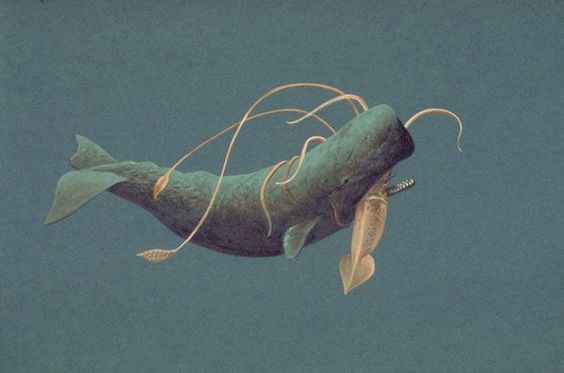
During this whole operation the whale is holding its breath. It’s a mammal and needs oxygen. The whale is capable of diving to over half a mile, sometimes to a mile under the surface of the sea, searching for its prey, and then engaging in a battle. The amount of time required for this can take over an hour. This is a remarkable animal.
The whales get to eat the squid. Can you imagine? At this very moment this scene is being played out. The whale rolls lazily on the surface, takes a deep breath, tips over frontward and begins its descent into the deep. After it gets deeper to where it suspects it can start a search the clicking begins slowly. As the depth increase at some point the whale gets an echo from its prey. Then the whale begins to shorten the pulses to rapid fire clicks to almost a buzz. The whale is no longer searching. It is locked onto an echo that guides it to its meal. The squid attempts to retreat and can’t. The whale grasps it firmly in its jaws and the squid claws, bites, and scratches to escape. Huge jaws clamp down firmly and crush the squid. It’s over.
Let’s go to a different place. During my three years assigned to drive the deep submersible I was hardly aware of the dangers. I don’t know how many dives I made into the darkest parts of the Pacific Ocean. There are two dives that stand out. One was a dive near the coast of Southern California. Biff Long was the co-pilot. We were taking a scientist on a look-see. I can’t remember if it was biology or geology related. During the first half hour of the descent all was proceeding normally. We descend at the rate of hundred feet per minute.
At the point of reaching eternal darkness the vehicle shook tremendously. It was just a few shakes but it was more than discernable. The motion was enough that I stopped the descent and checked all of the gauges as well as looking out through the viewports to see if anything was visible that could have caused the action. At the same time I told Biff to turn on the sonar and take a scan all around. Nothing showed on the ppi scope. It remained a mystery for the remainder of the dive.
When we returned to the surface a few hours later the swimmers discovered that the starboard after D ring was ripped from its mounting. The 5/8ths inch stainless steel material of the D ring was ripped in two. What could have happened? What could have caused such damage. We were nearly at 600 feet under the surface. None of our lines on board the mother ship were that long. I believe a force delivered by an independant being caused the mishap. To this day I haven’t been able to come close to what it was that tore the D ring in two. My imagination can only conjur up a creature with large type of teeth grasped us and couldn’t figure out how to eat us and released us.
The second instance happened on my final dive as the pilot. We were flying above the bottom in the dark as usual. I think it was Biff as co-pilot again. I’d asked Biff to drive as it was a good chance for him to get experience flying the submersible. I gave up my position by the forward viewport to him and took a seat at the back of the sphere on top of the gyro box.
Sitting there in the dim glow of the gauges that surround us in the sphere I reflected on this dive as my last and on the new duty station I would be going to on the East Coast. My mind wandered and I took a moment to stare up at the small two inch viewport that is in the center of the 24 inch access hatch at the top of the sphere. I stood slightly to peer through the viewport. Nothing could be seen. The viewport was totally black. I sat back down on the gyro box and it hit me. We were so deep I could see nothing while looking up. Then my imagination took over and took me to dark places that don’t feel safe. I shivered and knew I had to restore my equilibrium quickly. I grabbed our clipboard and began to take a set of readings of our gauges. That did the trick. I made a note to never do that again.
Over the years of diving in the Sea Cliff I was also doing a great deal of introspection. Second try at sobriety and recent divorce and living alone. The most uncomfortable places I’ve gone to in those years could not match the places I went inside myself during those periods of introspection. Those years were probably the messiest for me.
Peace out,
G. M. Goodwin
18 March 2018
 Playing Fair and Being Kind