ONE OF MY OLD HANGOUTS
SITTING UNDER A BOAT WITH JOHN MARITATO
John Maritato grew up in New York City. He learned to caulk boats in shipyards there from his father. John passed away in 2011 at the age of 89 years old. Caulking is a skill that many boatbuilders don’t normally have. Caulkers would do nothing but caulk the seams of wooden boats and were hired for that task only. A gang of caulkers would work along with other craftsmen during the building period and the noise they generated was raucous. The ring of the mallet against the caulking iron is a sharp ringing click that will penetrate the contents of one’s head behind the eardrums. Wax will fly out from inside the ear with a muzzle velocity that will send it hundreds of feet. Woe be the person standing in the line of fire. They will be waterproofed from head to toe.
I learned to be a wooden boatbuilder by attending the apprentice shop at the Maine Maritime Museum in Bath, Maine in 1987. I spent a year and a half building boats under the guidance and genius of Phil Shelton. (You can look him up on google.) After the apprenticeship period in Bath I found work in my new hometown of Boothbay with Jimmy Jones, a third generation boatbuilder. I worked with Jimmy for about four years and then struck out on my own when work slacked. I sub-contracted with various yards in the Boothbay Region. I did all sorts of work on boats; re-planking, trim, cabinetry, framing, repairs above and below the waterlines. There came a time when I realized my age was getting in the way of much of the heavy work. Planking of larger boats was brute work. Oak planks two inches thick, eight inches wide, and sixteen feet long are tremendously heavy to lug up staging and fit in place. We never worked alone. It took two strong men to handle planks that size. I needed to find an easier job. Along came John Maritato.
John was in his seventies when I met him. We were both working at Sample’s Ship Yard in Boothbay Harbor. He was caulking the planking on the bottom of a commuter from Larchmont, NY. I was slacking off and dropped down into the drydock to sit with him. We’d only met once or twice before and I was curious about his craft. For several days I showed interest in what John was doing so we ended up talking more and more. Eventually, through several conversations and sharing histories John and I became regular mates under the boat. He taught me how to caulk. One major trick he showed me was how to hold the mallet and swing it with my elbow tucked into my waist to gain leverage and not lose energy. A man could swing from there all day long and not grow too weary. Here’s a guy driving cotton into seams.
One day not long after I began helping John to clean out plank seams and prime them with paint, he let me actually begin filling seams with cotton. John had been friendly all of the time until this one event. I was using one of John’s caulking mallets. He was coaching me all the while he was nearby putting in a second layer. When I got to the end of a roll, I asked him how to continue. He said, “Take the end of another roll and just marry the two ends.” I knew what he meant but I wondered if there was a secret technique to the ‘marrying’ part. So, instead of making up my own way of doing it I asked John if it was, “this way?”, holding one of the ends over the other end slightly crossed. He glanced my way and then almost yelled, “Just marry the fucking things!” Honeymoon over.
I began caulking from then on. It was easier than planking, for sure. Still, caulking is rugged work until one gets the hang of it. I was never afraid to approach caulking after that.
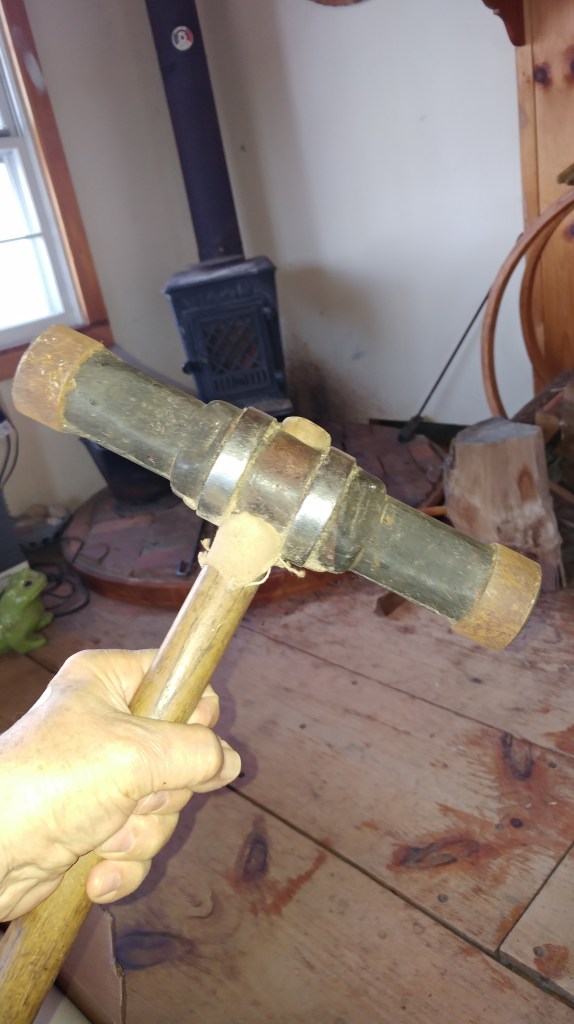

John let me use his mallets and irons until I began collecting my own irons. He gave me one of his mallets and also one of his father’s mallets. This was no minor gesture, in my estimation. I took these gifts as treasures. I used them for a few years until the work ran out eventually. I saw John less frequently. He was getting tired of working and traveling to find the work. John lived in Waldoboro, about twenty miles up the coast. Home of the five-masted schooner. One time when we ran into each other at a mall somewhere along the coast he told me that he missed working under the boats. He laughed as he told me that to stay in shape, he caulked the boards above the entry way over his front door at his house. We laughed and parted ways. He passed away several years later. His obituary tells his story better than I can. https://lcnme.com/obituaries/john-jack-l-maritato/
G. M. Goodwin
20 December 2018
 Playing Fair and Being Kind
Love that tale! Our first boat was wood, one night while staying overnight, hubby working an overnight shift, I realized water pump working a “lot”. I went to a boater with wood boat wisdom,
He check out my issue and proceeded to teach me to caulk a wood boat from the inside hull.
It took a putty knife, rag mop and me climbing into the hull of the boat …. Awesome! New skill, renewed appreciation of my neighbors wisdom/expertise. (Picture a smug smile)
You always have a smile, Nancylee!