JUST ANOTHER JOB
More or less
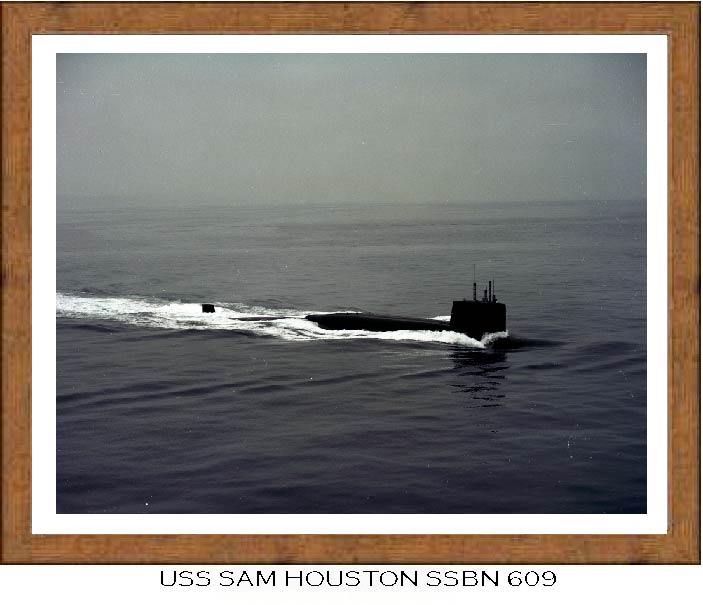
Early in my Navy career as a crew member of one of the Navy’s new nuclear submarines we’d been at sea for a few weeks testing the ship’s control systems. We were off the east coast. The submarine had surfaced in preparation for entering port. I came up from below during Special Sea and Anchor detail and the air hit me like a hammer. It smelled like I’d walked into a teenager’s bed room. Body smells, factory smells, fish smells, smells of industry and neglected populations. We were a few miles outside of Charleston, South Carolina. My job was line handler on line 5 and the USS Sam Houston was returning from a sea trial to enter the ship yard in Charleston for a few minor repairs and adjustments before continuing south. The air was hot and smelly and heavy with surface-of-the-earth details. It reeked. This was an unexpected occurrence.
What led to this of course was the fact that we had been submerged long enough to lose olfactory touch with humanity. The controlled atmosphere of a nuclear submarine erases the memory of outside sensations. Noises, temperature swings, smells and tastes all disappear from one’s life while enclosed in the hull. Another sense that gets messed with is the optical nerve. Everything is within a few feet inside the submarine so that when one first goes topside the sensation of seeing things at great distance is a rush. The restricted boundaries felt inside the submarine are relaxed and the mind leaps within the head to joyously engage the new limit. It is, like I said, a rush.
So when I came topside off the coast of Charleston the sensations reeled. It took me a few minutes to gather my senses, to adjust to the new conditions. Getting back to the inside of the submarine, the air is the same air that we went to sea with. No air is added. The air we had inside the submarine is the same for as long as we are closed up tight and under water. There are approximately one hundred and twenty crew on board inhaling and exhaling the air for sixty days or more. Two months. One hundred and twenty crew. How do we do it? Easy, but not simple.
In the passageway near the Navigation Center, where I worked, is a monitoring device about the size of a small bureau that has tubes attached from every compartment in the submarine. The device is called an atmospheric analyzer. That’s what it does. The machine selects a tube internally and pulls air through the tube from the selected compartment to electrify, zap, and measure the quality of the air. There are dials and gauges on the face of the analyzer that indicate limits and parameters for various chemicals that are detected. It is the only way to determine if the air we are breathing inside the submarine is safe enough for the one hundred and twenty crew to breathe. The ship’s doctor and the corpsman are the people responsible for monitoring regularly the atmosphere conditions within the submarine.
Meanwhile there are several other machines on board that are needed to correct the impurities that build up in the atmosphere while we are under water and sealed away from the usual supply of air above. On board the submarine are larger devices that generate oxygen from seawater and that remove CO2 from the crew exhalations and burning of oxygen by other devices. The equipment that removes carbon dioxide from the atmosphere that we breathe is called a scrubber. Here is a link to a page that will give you the theory of operation of a scrubber.
http://www93.homepage.villanova.edu/michael.b.walsh/CO2Scrubber.htm
Hydrogen is a substance that adds to the hostile conditions. Hydrogen is generated primarily by the batteries in the submarine. Submarines have large batteries that store energy for emergency and auxiliary use. During their normal operation, and especially during charging, batteries give off large amounts of hydrogen which can reach explosive concentrations if not ventilated away from the battery compartment. Therefore the submarine has another large machine that focuses on removing excess amounts of hydrogen. The machine is called a burner. It combines the excess hydrogen with carbon monoxide to make water and is pumped overboard. This link will vaguely describe the operation of a hydrogen burner.
http://www.naval-technology.com/contractors/hvac/atmosphere-control-international/
Oxygen is generated by a larger machine that through electrolysis pulls the oxygen molecules out of seawater. The newly acquired oxygen is stored in banks aboard the submarine, outside the hull, and the left over hydrogen is washed overboard. Here is a link to how a O2 generator works.
So the atmosphere is monitored and regulated continually while the submarine is submerged.
That’s a lot of information but it’s only part of the air purification story. The chemicals used to manufacture the submarine, to glue the Formica to the bulkheads, to clothe the crew, to wash the dishes and generally provide for the operation of the ship add toxins to the air. All the toxins need to be controlled or eliminated. Selection of materials for the shipbuilding events are carefully selected to prevent too much toxicity from fabrics and materials. I remember that we needed to wear lint free fabrics. Our uniforms and towels and wash cloths were all specially manufactured for this use. The fabric used in the towels were synthetics and would never dry us off. The was no absorption. All the towel did was to push the water around on the skin. It was a compromise that was barely tolerable.
It is common knowledge within the submarine community that just one really good clean up is needed after the ship submerges because there is no way to accumulate any dirt once we dive. With the exception of paper waste and garbage from the mess hall there is little trash to mess up the submarine spaces. What dust that did settle on the machinery and other equipment was usually skin flakes and rogue dust mites. Gross, eh?
So here we are, underwater with lint free clothing, machines that remove carbon dioxide and hydrogen, and another monster that replenishes the oxygen in the air. There are also air conditioning heaters and coolers, humidifiers, dryers, and filters. The air moves through the submarine by ducting and fans. After a few days submerged the human body begins to clean up as well in response to the atmosphere control. You can imagine now that after a few months living in these purified conditions the shock it was for me to climb out the hatch and suddenly be confronted with the earth’s atmosphere off the coast of South Carolina.
The stimulus for this writing began a few days previous. I was reminiscing, reflecting on parts of my life that never came in touch with the rest of the world. I made nine underwater patrols on nuclear submarines. Each patrol lasted about two months. The shortest patrol was one that was broken into two parts with a quick shore call at Izmir, Turkey. Each of the two parts were nearly one month in duration. The longest patrol was 72 days. Honestly, the length of time was not important to me after the first two or three weeks. I was comfortable with the situation and I rarely was eager to return from sea. There are a lot of modifiers and conditions included in that last sentence which we can ignore for this time.
The point I want to make here is that all of those patrols in which I was out of touch with events of the outer world gave me a separate set of problems that were not immediately obvious. The isolation from current events at home or within the boarders of the U.S. left blank spaces in my character. There were missing building blocks. Simple items such as music, sports events, dances, jokes, shifts in cultural norms, weather events; generally speaking, life. I recall once arriving home in July to be placed among a group of family members who were tanned and athletic which served to amplify my own pale and sickly appearance. Years later I would be baffled by references to people whom I’d never met or heard of because when they had become noticeable I was under the sea far, far away. In fact the generation I was a member of transitioned from the nineteen forties to the nineteen sixties causing my friends and I to face a split in philosophies that separated us into two groups. There were those who continued to support the capitalist conservative sector of our culture and those who were forgotten and unhappy with how things were and decided to explore the later generation of those who questioned authority. Neither group was pure and law abiding mind you but there was a difference that showed the rebelliousness of us who felt left out and under recognized.
In my case I felt the rebelliousness, and I still do, but during the early days of my Navy career I was slow to respond. After all, I was a product of a system that pretended to be loving of justice, equality, and fair play. I was an unhappy citizen of a country that was only interested in conquering the world but at the same time I was only able to identify with confused and forgotten formerly entitled white males who were beneficiaries of successful entitled white males. As a result I was locked into a position of defending and protecting the system that maintained the status quo; the system that held back anyone who exhibited an ability to grow out of the common population.
I left high school in the fifties and joined the Navy a few years later. I retained my slightly conservative nature and an uptight sexual stance that was in constant tension with my natural interior healthy libido. I was messed up. I knew it but in those days few if any males admitted to insightful thoughts. I felt miserable with the tension and I searched, sporadically, for relief and release without success. The sixties were a mini-death for me. I was committed to being a warrior of the best military in the world and I vowed to protect that concept from enemies both inside and outside our boarders. In reality I was a double agent hidden from everyone including myself. I think I became aware of my situation when I was thirty one years old. I started to see a huge difference in the young men in the Navy from those I joined up with in the fifties. The major events and behaviors of the seventies began to clarify for me the gap.
That gap was illustrated with lack of respect for authority, drug use, disgust with those who used alcohol, and a general distrust of anyone over the age of 30 (me). I recall the dividing line of the younger generation was stated by referring to older military as “juicers” and the younger military as “heads”. I was a juicer. I crossed over a bit to being a head before it was old news. To be honest the wake up call was quite rude. To my credit I was willing to examine the differences of my generation to those of the later boomers. I saw the opportunities available and I took them. It took me some time but I was able to incorporate new ideas and I had a natural affinity to empathize with the down trodden. After all, I was a complete failure as a high school student and what little education that I’d gleaned from four years of misery I was ripe for a better way to live and to seek some pleasure from my position in life.
Not everything was so clear though. All these minor gains in my existence took time. Lots of time. I lost track of normal life during the sixties because of my sea duties. I was at sea most of the time and I was also pretending to have a family and be the father of three great children all of whom were too much for me to handle with my limited ego functioning and poor self image. When the seventies came around I was so far behind and out of touch with the general population that I was exhibiting idiotic behavior. Not so’s you’d notice though. I kept up a cool facade. Not many people guessed there was an empty shell of a man inside that pretty uniform I was wearing.
I’ve been rambling along here more or less using free association. I’ve gotten this piece to the point where I’d like to finish on an upbeat note but upon further reflection I think it is okay the way it is. My job on the submarines was fun but there was a price to pay. I missed out on things and I also gained a great deal of experience that can never be duplicated. I lost a good family as a result of sea duty and other factors which made for poor conditions that couldn’t support us. That is life.
I hope your day is comfortable and that you are getting your needs met.
 Playing Fair and Being Kind
Very very interesting, George! Well done. Thanks, and Happy Holidays.
~ Robert
_____________________________
* * * *Turn differences into gifts. * * * *
Good to hear from you, Robert. Thanks.