I’ve seen real estate you wouldn’t believe. A few days ago I thought about how lucky I am. In 1976 I was due for another transfer to a new duty station in the Navy. I was winding up a two year tour at “Fighter Town U.S.A.”, Mirimar Naval Air Station in California. I was Director, Counseling and Assistance Center (CAAC). It was by far the most fun and easy tour of duty I ever had. The job was way outside my normal job description which made it more fun. But now it was time to move on and go back to the fleet in the submarine force. I had talked with my detailer who worked at the Pentagon. He’s the guy who keeps all the jobs filled and oversees the rotations of officer personnel through the chain of events that are foisted upon the Navy’s manpower.
He and I knew each other from a few years before. In fact he was instrumental in helping me escape the submarine force temporarily to go to work for a whole different group. The CAAC job was under the Chief of Naval Personnel, Administration Division. Anyway when it was time to go back to duty at sea this guy and I talked on the phone a few months in advance to discuss my options and the needs of the Navy. Both he and I had worked previously in San Diego for Submarine Development Group 2 (SUBDEVGRU2). So he had a close tie with the Development Group and knew their needs. The billet for Engineering Officer on Sea Cliff DSV-4 was available and he thought I might like that.
When I heard the suggestion I was a little surprised at my reaction. My stomach turned slightly because I knew the Sea Cliff was a deep submersible and my borderline post traumatic stress condition with deep diving submarines was still a memory. Like all submariners of the time I was still affected by the loss of the Thresher and Scorpion submarines with all hands. Both were nuclear powered deep diving boats and their loss deeply affected the submarine community. I asked my friend on the phone how deep the Sea Cliff operated and he said, “Sixty-five hundred feet”. My brain headed out the door. The deepest I or any submariner ever went on the combat sub’s was twelve hundred feet. The Sea Cliff was more than five times that. To save face I told him I had to think about it and we hung up.
I went out to lunch and thought about it. I couldn’t get the concept out of my head. I could simply avoid the situation by passing on the opportunity and taking a more easy job elsewhere. I gave the idea a great deal of thought in those few hours and finally I came to the conclusion that I would forever regret passing up this chance to do something remarkable. All I could think was, “No balls, no blue chips”, one of my favorite motivational tools to live on the edge. I called him back and accepted the job. He was happy because it is a hard job to fill and he knew me and he knew I was already familiar with the operations of the Development Group.
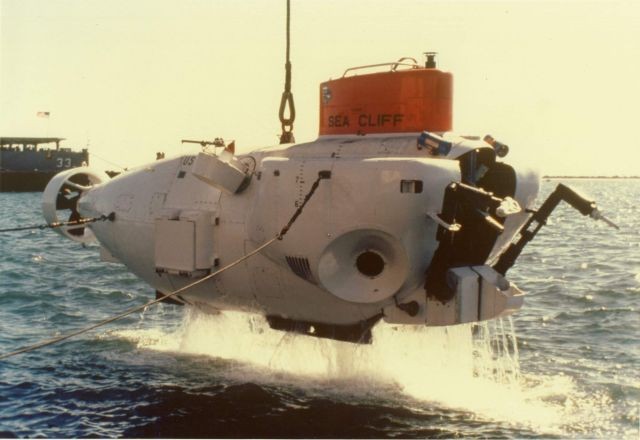
I reported to the Sea Cliff and began a period of certification as pilot. The crew consisted of three officers, Officer in Charge, Executive Officer, and Engineer. I was the Engineer. Besides being responsible for the material condition of the submersible I was a pilot along with the other officers. Several in the crew of nine enlisted men also were pilots. Most of them were co-pilots. The personnel sphere could hold three people. We usually dove with the three slots filled; pilot, co-pilot, observer/scientist.
The routine for a dive was involved but simply put the Sea Cliff would be lowered into the water and then four heavy nylon lines attached with pelican hooks to stainless steel pad eyes, guided by line handlers and divers, were used to position the submersible clear of the mother ship. There were four lines, two on each side. After the submersible was clear of the mother ship the line handlers would retrieve the lines after the divers had unhooked them from the pad eyes. The recovery of the submersible was the same in reverse. Attach the lines by hook to the pad eyes and guide the submersible to the lifting device whichever one we had available depending on the mother ship involved. Some had elevators, some had cranes with lifting I-beams.
One dive I made as pilot with Biff Long as co-pilot was eventful. After saying “Adios” to the divers we opened the vent for the ballast tank and submerged. The submersible sinks with assistance from the side pod motors. We rotate the pods to drive us in a vertical direction to break the surface tension and then sink with the use of our external weights at the rate of one hundred feet per minute. At that rate we can travel to a depth of six thousand feet in about an hour.
On this particular dive everything was behaving normally but just as we reached the mid-night region of depth, six hundred feet, there was a lurch in the attitude of the submersible. It was quite noticeable. Biff and I looked at each other. The scientist noticed it as well. I told Biff to turn on the sonar and take a search around while I strained to see through the view port if all outside was normal. I could see nothing amiss and Biff’s sonar search revealed nothing. We were still descending smoothly after the lurch so we didn’t give it another thought. The rest of the dive proceeded without incident and we dropped weights and returned to the surface.
We sat on the surface waiting for the divers to show up to prepare the submersible for recovery by the mother ship. There are two divers who perform this task. One of the divers found the after starboard pad eye was ripped in half. The half inch diameter stainless ring was torn away from its base. The diver had to attach the line to another point on the submersible. After the recovery operation was complete and we were all out of the personnel sphere we gave the pad eye a good look. We had no clue to what had happened. The lurch we had felt occurred in the dark part of the water column. We had no further information to explain the event. I still wonder and once in a while I return to the moment I felt the lurch and can only imagine something tearing a half inch stainless steel ring. I almost always imagine a huge denizen with sharp teeth grasping at the ring to wrestle the Sea Cliff into submission. Thought like this keep me alive and breathing. Just one of the stories about my three years on her.
G. M. Goodwin
15 December 2015
 Playing Fair and Being Kind
Interesting, George. very readable.
Sent from my iPhone
>
Thank you, Robert. Good to hear from you. The writers group was tonight and we missed seeing you. I hope you are well.