As my departure day approaches I am mindful of the food left at The Castle. I’m trying to use up the perishables first and also not leave any type of containers on the shelves in the pantry that will explode if frozen. This situation makes for interesting menus of late. Per example; this morning I ate barbecue chips. A whole bowl of them. It’s not that bad all the time. I’m eating more as I make this entry. They are some good!
Just a few days left before I leave on this 4th annual trip around the U.S. I am not as enthused about the driving part but I will be once the tires on the car are changed.
Here is something that took a lot of my attention this morning. Another submarine story mixed with other experiences regarding scary encounters. I need to publish this and get to work arranging the items that go into the car.
Have a great day. I hope the snow is manageable where ever you are. Good luck in the mountains of Virginia, Tennessee, and Georgia. Peace out.
AN ALTAR OF INSPIRATION
A Holey Adventure Place

My daily visit to the ceramic altar known simply as “the toilet” is normally an uneventful happening. The occasional thoughts come and go and whisper their usual greetings. I reminisce pleasurably and make small decisions or plans for the day. Sometimes I get a flash of inspiration for a subject to explore and write about. Such a wondrous “Aha” moment arrived just minutes ago. Before I reveal that moment I want to continue examining the connection of the locus to the focus that brings on the hocus-pocus, so to speak. Are you ready?
What is it about sticking our most private parts through a hole, a chilly and damp hole to be exact, that inspires deeper than normal thinking? Can you imagine the confusion of our base nature when we sit on a cold surface, naked, exposed to all sorts of imagination, to relieve our innards, and receive marvelous moving pictures and thoughts that would never come under more favorable conditions. The trip to the chilly, ceramic hole in the earth begins in one dimension and magically transits to this place that makes us complete, regally in control of our destinies, and let’s us write, or even re-write our existence. I’ve gone into the process and the why’s and wherefore’s a long time ago so I am familiar with what happens to some degree. What I know about it is pretty simple. The process of sitting quietly and waiting for certain functions to unfold allows the psyche to relax. Hidden, reluctant memories are encouraged to appear, to enter from behind the drapes of uncertainty, to feel free to join. There is a gestalt element at work here that is not really part of the plan of you and I. When these moments of inclusion of all our parts materialize, the mind’s eye can focus on an event or memory that triggers something so clear and important to our being we get that urge to rush to pen and paper. That is what happened this morning, just minutes ago.
I was thinking about scary events; what was the most scary event in my life. Here is where I need to qualify my event by stating it is not “The most scary event in my life”. There are more scary events that will remain private, not for print, at this point in time. The events I am willing to publicize are heroic in nature; that is, the event was endured and passed with me intact in all spheres. I survived physically, emotionally, and spiritually. I will describe two separate events that made me very worried, frightened, anxious, vexed, stymied, confused to the point of being focused intently on one item only. That situation which was in front of me and needed to be watched and negotiated right then and there. O.K. Here is number one.
I was crossing the Continental Divide during the month of April. Many of the roads were still closed for the winter season. I’d left Spokane at O dark thirty. I left Nancy sleeping in her warm bed and I stumbled out into the dark to my car. I found a gas station and then drove east toward Boothbay. As I drove I was aware of how many mountains I’d be crossing to reach the east coast. Along about mid-day I was up in the Rockies just east and south of Butte, Montana. The weather was still cold and not all the east-west roads had been opened by the state authorities in Washington, Idaho, and Montana. Interstate 90 was open. Traffic was light and I and several other cars plus an assortment of trucks were politely crawling the grades that led us to the heights of the Divide. The road twisted and rose ahead of us and the weather was wet enough to make me use the wipers once in a while. On occasion a highway marker would ghost by on the right side of the road announcing “Continental Divide”. I was becoming a little anxious because as we gained elevation the air was much colder and I noticed the drops gathering on the windshield were beginning to show ice crystals in them. I had no experience driving in these conditions with regular highway tires and going uphill continuously.

The traffic slowed considerably as soon as the precipitation changed over to light snow. Now the traffic was bunched behind a series of vehicles moving cautiously higher still. The road surface now was covered with wet snow and tracks were forming. The rate of travel was slow but I could feel the traction had changed. The SAAB was slipping a little once in a while. There was no way to gain a sense of relationship with the outside world. The sky was definitely surrounding us and was gray and foggy and the edges of the highway were masked by the heavy wet snow falling, blocking out any view of anything beyond the guard rails. The next ghosting of “Continental Divide” gave me quite an ominous feeling. The highway marker slid by and my eyes got a little wider and my butt got a little tighter. The road conditions were deteriorating quickly and the highway was still rising. I maintained my composure with the universal mistake of believing that if these other guys were still moving forward things must be all right. The road continued rising and the snow was getting heavier and the traffic continued to slow to below twenty five miles per hour, thankfully. I used the comparison strategy of “Hey if that Toyota is capable so is my SAAB”. Any port or straw in a storm right?
We all made it to the top of the highest elevation and even though there was no noticeable up then down sensation I felt better that this was the place where it could get no worse. Again, false assumptions. Just the same I made it through the scary part and the slow release of tensions and fears came. Later, after all my systems had returned to normal, I reflected on this experience. I was scared, afraid, and worried beyond worry. Now I want to examine scary situation number two.
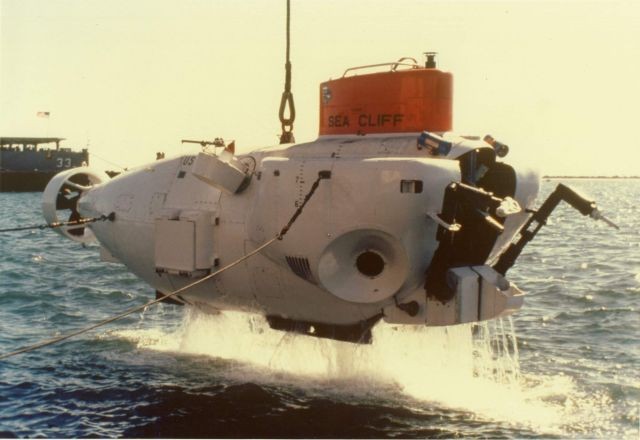
Way, way back in the seventies while I was still in the Navy I was privileged to be the Engineering Officer on the deep submersible Sea Cliff. The Sea Cliff was capable then of diving to six thousand five hundred feet deep. That is over a mile, straight down. The thing about that kind of job, driving the Sea Cliff in water that allows dives that deep, is there are no resources to come rescue you. Nobody can come and find you and help you come back to the surface. Driving a deep submersible is very much like going off into space. Who’s going to come and get you? My point here is that deep submersible pilots and others inside the sphere are on their own once the boat goes past a certain depth where the human scuba divers can’t respond and attach a line or some other device. With this in mind let’s go someplace where we can’t be rescued.
The Sea Cliff was deployed from its home base of San Diego, California to Kauai, Hawaii. We used the vessel “Maxine D.” for a launch and recovery platform. The island of Kauai lies to the northwest of Oahu and is called “The Garden Island”. When I was there with Sea Cliff in 1979 it was a still small and quiet place. I don’t know how it is today but from my experiences around the rest of the world with population growth I can only assume the island is much busier and crowded. We used the C and H sugar company pier in Nawiliwili Bay for our home port. Our mission was to make as many dives as possible on the underwater array of hydrophones off the west coast of Kauai in the vicinity of Barking Sands. The problem this mission was to solve was the hydrophones inclination to drift out of position because of ocean currents dragging them around over time. After a few years the hydrophone array was not precise enough for its mission, whatever that is. Hush hush.
So there we were spending time in port and making daily trips to sea to dive on the hydrophone array. The problem we encountered was a frustrating weather pattern that prevented us from launching the boat safely. We launched the boat using a fifty ton capacity crane that was permanently fixed to the deck of the Maxine D. In and of itself that evolution is totally complete with plenty of hazards. With the rushing about on a pitching deck handling chains, binders, nylon lines, decks awash and massive objects and bodies in constant motion and varying degrees of instability this is no place for the clumsy nor the wandering mind.

So when we arrived at the dive location a decision had to be made regarding the weather forecast and the sea conditions for the next eight to ten hours, the usual duration of a launch, dive, and recovery operation. If the sea was going to be above a specific state which includes wave height, distance from wave top to wave top, wind speed and direction then we had to decide if we could go to work. If not we had to turn around and go back to port. The trip to the dive area from Nawiliwili Bay was three or more hours and of course round trip including the time to observe and decide the dive conditions took all day. The frustrations mounted with the needs to keep the Maxine D. and Sea Cliff harbored safely and to travel each day to make the assessment. The Maxine D. skipper tried using a closer harbor to Barking Sands which proved hazardous. The prevailing winds and seas in Hanapepe Bay, which is about midway from Nawiliwili to Barking Sands, were overwhelming and the first day we tried staying there the movement of Maxine D. at the dock snapped several lines and the boat rocked and pitched so much it was nerve racking as well as dangerous. As a result we resorted to making the daily eight or nine hour round trips. The result was that we made only one dive in about six weeks of operations. No proud accomplishment, to be sure. What we did accomplish was the crew got to go to the beach each day after we returned and we got to become beach volley ball commandos. Not a bad result.
So, the one dive we made was my dive. I need to explain here that we had three certified deep submersible operators in our crew. The three officers, me included, were trained and certified so we rotated dives between us three. The rotation was fairly strict so it was my dive next and the only dive we accomplished was mine. This is the event that was one of the most scary on my list mentioned above. The weather was manageable and the boat was ready in all respects when we arrived at the dive location in the usual manner. We launched the boat and I and my co-pilot got into the submersible in good fashion. We closed the hatch and opened the vent for our ballast tank and began driving for the bottom of the ocean.
The hydrophone array is arranged in a grid pattern with all of them wired to a monitoring station on the beach near Barking Sands. The array begins a few thousand yards off shore and continues for quite a distance of a few miles. The hydrophones in the array nearer the shore are in shallower water and as they get farther from shore the depths of the hydrophones sit deeper following the natural slope of land. The hydrophone I was tasked to check on was far out in the array and probably several thousand feet deep. Over two thousand if I remember correctly. The dive was progressing normally. The submersible can dive at a rate of a hundred feet per minute so it would take us about twenty minutes to get to the ocean bottom. At six hundred feet we lose daylight and the ocean becomes pitch black. This is not a problem because we have external lights on the boat to illuminate the area we are working in.
Our method of communication with the Maxine D. during dives is by an underwater transmitting telephone that’s been around forever. The UQC underwater telephone is standard submarine equipment. It transmits at around thirteen kilohertz and is reliable in most sea conditions. We have used the UQC on Sea Cliff all the way to six thousand five hundred feet with good results. There are two methods of transmitting on the UQC. The most convenient is using normal voice and the other is using a key to send Morse code. When Morse code is necessary or for routine coded transmissions we only send one letter for a phrase or routine announcement. The “H”, Hotel, is used to query “Are you O.K.?” The response is the same letter meaning “I am O.K.” The letter “R”, Romeo, is used to acknowledge a message was received clearly. Hotel is “dit, dit, dit, dit”. Romeo is “dit, dah, dit”. Pretty simple stuff actually. As the boat is descending or ascending we transmit “Hotel” every hundred feet to keep the surface operators informed and to ensure that the communication link is intact. While we are on the bottom we also transmit “Hotel” every fifteen minutes if there are no other communications passed. If the surface operators haven’t heard from the boat in a fifteen minute period then they will transmit “Hotel” to initiate a call and response. They will continue to transmit “Hotel” until a response is heard.
During the dive we were operating the boat to maintain a rate of descent of a hundred feet per minute by using the side pod motors. These motors are one on each side of the submersible and can be rotated three hundred and sixty degrees continuously. The propellers in the side pod are variable speed so we have control of our speed up, down, forward, and back. During descent we don’t normally use the main propulsion motor on the back of the boat. When we were close to the bottom and we were slowing our descent we received a voice message from the surface ordering us to abort the dive. Shit! What?!?
Ordinarily there is no panic or anxiety associated with the dive itself. This was an abnormal situation though. We hardly ever get called off a dive task. I initially thought that the weather conditions topside must have deteriorated to a point that we needed to get back up so the crew would have a least hazardous opportunity to get the boat back on board the Maxine D. This was not the case however. In a brief voice transmission the surface control watch informed us that a submarine was in the vicinity and needed to use the hydrophone array. Since the submarine is a war ship and our mission was simply a maintenance function we needed to defer and get the hell out of the way. My anxiety level increased about thirty percent. What caused it to go up was I didn’t know where in the array the submarine was or if it was hanging around a mile away getting impatient.
Here I will give you my impression of submariners when they are on their way to their patrol area. They are preoccupied with the mission they are given and they don’t want anyone to delay the job. I spent about eleven years riding the submarines. I know their schedule is tight and they have places to go and people to spy on. I imagined the submarine crew chomping at the bit to get their sound survey completed so they could get on their way. There they were at about a hundred or so feet below the surface of the ocean near the array. Here I was much deeper than they can travel safely but in a location that required me to ascend through their layer to get to safety. I was concerned I would be too small for them to detect with their sonar so if they were close to my column of water they might just run into me.
I had no way of determining where they were. I only know they were somewhere in the vicinity of the array probably moving at some speed to maintain depth control and heading. No matter how slowly each of us was going if we just bumped into each other slightly there would be no way for Sea Cliff to survive. Just for illustration purposes you need to know that the Sea Cliff is about the size of a very small bus and the submarine is as long as a football field and over three stories tall. No contest in a bump of any proportion. Realistically, the other submarine was nowhere near the array. They would be ordered to maintain a specific safe distance from the array until I was clear and back on board Maxine D. That is not how my mind was working though. My imagination took me for a little walk down that dark staircase where the monster guy has all of his chainsaws and knives. So for a few moments I had the pleasure of watching horror films of a huge submarine cruising blindly toward the Sea Cliff as we ascended from the depths.
This is one of the scary moments of my life; those few minutes fantasizing about a certain underwater collision and sinking to a depth where no one could reach us, beyond the capability of normal diving operations, too far from another deep submersible that would be able to dive on us and attach a rescue line. Alas and alack!
Well, there you have it. We surfaced just fine and the crew got us back aboard in good shape. I didn’t get to play volley ball that day and it didn’t even enter my mind.
G. M. Goodwin
23 January 2016
 Playing Fair and Being Kind
Very interesting descriptions, tension that draws me in. What’s going to happen next? ~ Robert
Sent from my iPhone
>
Thanks for commenting, Robert. I may start working on the library of beginning stories I have stored on my laptop. There is a lot of material I have begun but haven’t taken the time to finish. I may get into those next.