I have been reading some tantalizing stuff lately. Psych stuff. Knowing one’s self. Being present. Letting things unfold. Patience, tolerance, recognition of self in the place one is, where one lives and breathes. The Shadow. The Dark side of our psyche. The difference between the two. So I wrote this piece today using knowledge and experience. I hope it flies straight. Have a great day. Today is Mark’s birthday. Happy Birthday, Mark!
G. M. Goodwin
17 September 2017
SPLITTING HAIRS
Perhaps not the best title for this. Just the same it leaves me less frustrated knowing that there are tiny but significant facts that can drastically change the perception or outcome of an action. This goes beyond navel gazing or picking fly shit out of pepper. I’m thinking about the time it takes for the now to get into the conscious from the time it happens. To be exact, according to me, there is no now in our conscious only the very recent past. The time the activity we think is now gets to our brain and we react mindfully is about point one seven seconds. (0.17)
So if something happens to wipe out one’s existence within the range of zero to point one seven seconds one will not be aware of it. (0 to 0.17) This is a comfort to me. When I was piloting a deep submersible during my youth in the seventies there were relaxed moments when I had time to reflect on where I was and the dangers involved. I recall the times when we were submerged and descending toward the ocean floor and we had little to do but wait until we got there. It was like riding an elevator in that once the door closes and the box begins moving there is nothing to do but avoid eye contact or smile briefly at others and wish the ride was over. Those were the times when I would be able to let my mind take me outside the vehicle and wonder about the water, how much it weighed, how much the sphere was pushing back, etc. A few times we would contemplate what the end would be like if the sphere in which we were riding suddenly failed. Consensus indicated that we would not know when it happened. Splat!
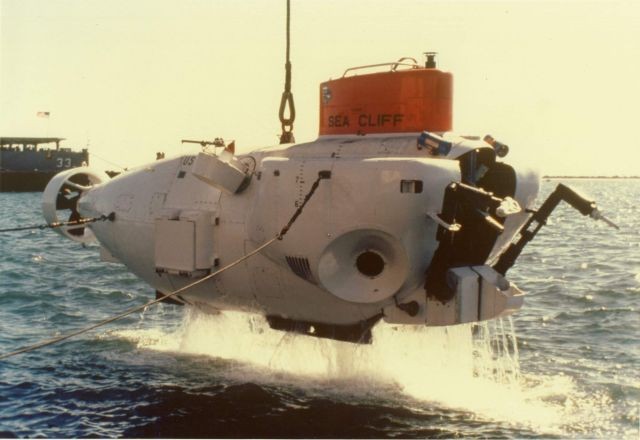
Although we did imagine the possibility of the solid transparent plastic windows failing in such a way that would give us an indication that we were too deep. The consensus in this failure scenario was that the external pressure would be so great as to liquefy the window to the point that it would begin to extrude into the sphere. You see the windows were cone shaped; four inches in diameter to twelve inches in diameter in a distance of three inches. Quite a broad based cone actually. The skin of the submersible was machined to allow this cone to fit perfectly. In fact the cone shaped window was held in place only with a stainless steel ring screwed around the perimeter of the outside edge. The sea pressure held the thing tightly against the surface of the machined hole. It was a perfect fit and the sealing was enhanced with a thin layer of petroleum jelly on the matching surfaces. All this description was not part of the conversation though. What we talked about was, as the pilot, what we would do if we saw the viewport begin to extrude into our faces as we were looking out. We wondered how fast the thing would be squeezing through the hole and if we would have time to reverse our side pods to give us lift to reduce the external pressure. Laughable to us. No one wanted to find out or ever to experiment.
The depth we operated at was over a mile deep. That was in the late seventies. We could operate down to 2,000 meters. That’s a mile and a quarter. We had our depth indication devices calibrated in ‘feet’. We stayed above 6,500 feet. On one dive I convinced the O in C to allow me to go deeper. I was the pilot, he was co-pilot. We were in search of a sea mount. The top of the sea mount was approximately 6,400 feet under the ocean’s surface. We were searching for it. This was in the Sea of Cortez along the edge of the Pacific Plate down near Mazatlan. The scientist on board was Peter Lonsdale of Scripps Institution of Oceanography, UCSD. Peter had visited the sea mount at an earlier date and had a desire to go back for another look-see. We couldn’t find it. The previous dive by another submersible, maybe Turtle DSV-3, was concluded by leaving a 12 kilohertz pinger at the site. The pinger is used to home in. The vehicle searching for the pinger transmits a 12 kilohertz signal pulse and the pinger receives the pulse and responds likewise. The pinger left at the site wasn’t working. So we were down at 6,500 feet flying around in the water column keeping our eyes peeled for the mountain top. We did so for about twenty minutes with no luck. During this time I noticed the inside depth gauge and the external depth gauge were not reading the same. There was a two hundred foot discrepancy.
The inside depth gauge was digital; still relatively new to users in the field. The outside depth gauge was analog; reading directly from the sea pressure on the case of the device. Of course I believed the outside gauge because it was technology I was intimately familiar with. The outside gauge was reading 6,300 feet while the inside gauge (digital) was reading 6.500 feet. So I talked Charlie Gragg into going deeper by using the outside gauge. We did. The inside gauge read 6,700 feet during this manuver. Still no sea mount after a thorough search of the vicinity. We gave up after a while and returned to the surface to be recovered by the mother ship. When we returned to our home port I had both gauges sent over to the repair ship for calibration. The digital gauge was on the money. We were deep. Deeper than allowable operating depth. We didn’t report the excursion.
So I want to go back to the point one seven seconds issue. (0.17) I’ve reported before, I believe, that for many years the USS Thresher sinking left an indelible picture in the minds of many submarine sailors. The imaginations were busy conjuring up how things must have been during the final moments during the tragic events. What we now know is that the sinking was preceded by a catastrophic event. The submarine imploded end to end like a telescope. The pressure of the sea pushed the after end of Thresher into the forward end. The collapse took point one zero seconds. (0.10) Faster than the human brain can recognize anything. The crew did not suffer their end. I feel better knowing this. Most of the PTSD issues I have relate to this incident in 1963. There have been other events afterward. The sinking of the Thresher was the most effectual.
Another phenomenon with a catastrophic event like a pressure hull collapse that deep in the ocean that happens in less than point one seven seconds (0.17) is the air inside the vessel will ignite due to the sudden compression, just like inside the cylinder of a diesel engine. Everything in the space would be ignited in a flash. Zap! Faster than anyone could know. So during those long descents from the surface to our operating depth (we descended at the rate of one hundred feet per minute) I would sit and look around the inside of the sphere, taking periodic readings and chatting with the scientist or my co-pilot but my mind would be lingering around these other thoughts.
And to conclude the point of never living in the now; it’s not possible to do so. By the time you are aware of what is happening you are already in the past of the recent now. Just a thought.
G. M. Goodwin
17 September 2017
 Playing Fair and Being Kind
Deep thoughts, George. 😉
Do you mean I was thinking while at depth? 🙂
Good to hear from you, Lynne.
I hope autumn is making Minnesota glorious.