Indelibly marked onto my brain are those days of hotbunking. Oddly, I have no personal experience with the activity. I didn’t have a bunk on the boat for about a week. My first trip to sea was a rush job. I was recruited directly off the submarine tender Orion; no sub-school.
By chance I’d been friends with another new sailor on the tender who was, like me, assigned to X division where all of the new crew spent a few weeks doing odd jobs until the paperwork was complete and we were officially wecomed into our respective destination jobs for which we were trained. I was ticketed for the Electronics Repair Division of the Repair Department. He’d gotten wind of the Submarine Squadron admin looking for volunteers to go directly aboard short-handed submarines in the squadron. He found me on the main deck starboard side where I usually hung out gazing longingly at the boats alongside.
“Hey, Goody! The squadron office is looking for volunteers to go on the submarines!” We didn’t know yet that these long dark shapes floating alongside were known as “boats”. They were always called “boats” by the crews. That was what helped to distinquish this odd collection of war-ships from all the others. Unconventional in all respects. Elite from the beginning because of the hazardous elements and the largely uncomfortable mode of living in tight spaces. Not only were the spaces tight but also oily, greasy, sweaty, hot, cold, wet, small, and any other adjective that delivered contusions and lacerations on a regular basis.
“Hey, Goody! Go on down to the squadron office and get on one of the submarines!” I was gone like a flash. I didn’t like the Orion. It was too big and I had precognition capabilities on tap. I was not going to survive the strict U. S. Navy style of living that was available on Orion. I needed to be in a more quirky environment. My senses proved to be accurate.
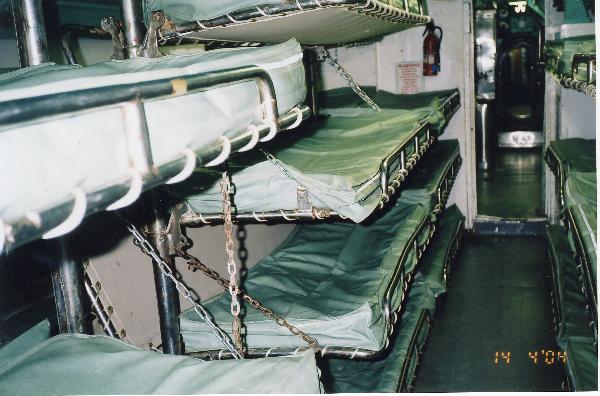
I was aboard a few days when we got underway for about a week. I think we were providing target services to a few destroyers who needed to work out some issues. That’s all beside the point here though. My focus on this trip was finding a place to sleep. I was not a watch stander because a. I was too new and b. I didn’t know anything. This combination made me an observer/passenger. No one seemed to worry about where I was going to bunk or where I was going to spend my time. Boat sailors are a strange lot in some ways. They care but not overtly.
EDIT: I totes forgot to describe the hotbunking strategy and technique. Two bunks are assigned to three crewmen. One man is always on watch while the other two have access to the bunks. When one gets up to relieve the one on watch the bunk is still warm when that man comes down to the berthing area to go to bed. We stood three watch sections which means that the watches were four hours on and eight hours off; two watches in a twenty four hour day. End of EDIT.
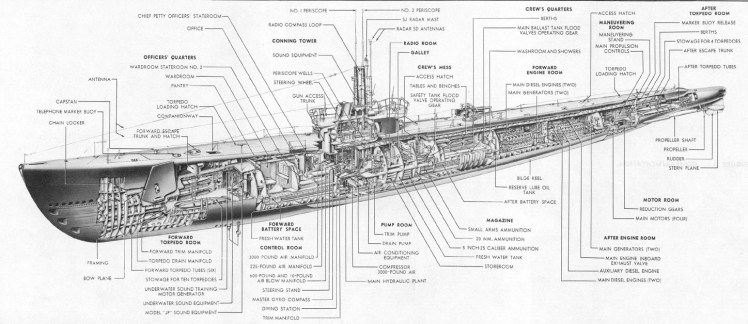
I didn’t dare go aft of the after battery. That’s where the engine rooms were and they were too scarey and confusing to pass through. At this point I should say that an old fleet boat was a string of compartments like a sausage links. Beginning forward with the forward torpedo room, next is the forward battery where the officers berthing and mess is over the forward battery (there are two batteries), the control room with conning tower over are next in line, then comes the after battery where the crew’s berthing and mess are over the after battery, further aft is the forward engine room and the after engine room. The motor room or “maneuvering” comes next. Last is the after torpedo room.
The first day at sea I was weary of walking around the submarine looking at things and being as inconspicuous as possible. Somebody recognized I might like to go crash so they suggested I just find a bunk in the after battery compartment and crawl into it. I was told not to unzip the flash cover but to just lie on top of it which I did. Not a few minutes later someone came by to wake me up and tell me to move out of his bunk which I did.
I stumbled around toward the control room and on forward to the torpedo room. The forward room watch told me I could go under the deck plates forward where the sea bags are stored if I wanted a place to crash. Apparently that is the overflow sleeping space. I lifted the deck hatch just aft of the torpedo tubes and discovered a deep, dark space filled with the crew’s sea bags. I dropped through the opening and found a comfortable layer of packed sea bags upon which to stretch out. Luxury! I also discovered another body down there. I was not the only resident of the place. I slept. That was my bunk for the whole week. I just had to be careful when I crawled out from under the deck plates that no one was transiting above. I found out I was sleeping over the forward trim tank. You may be able to spot my sleeping arrangement on the diagram above. Hint: it’s where the words “Forward Torpedo Room” are. Just above that and a bit forward of the torpedoes pictured. Cool, huh?
After this one week trip was over my senior petty officer, Harold Webster found me a bunk in the forward torpedo room. A skid rack that was usable unless the torpedo men were moving torpedos around which they did with regularity when we were in port. So then I could use a rack which was not a rack used for hot bunking. It was all mine. I still had no locker so I was forced to keep my stuff in my sea bag under the deck plates. When I got a locker six months later it was large enough to hold a pair of shoes and nothing else. That was my locker for two years. I wouldn’t trade my life then for anything.
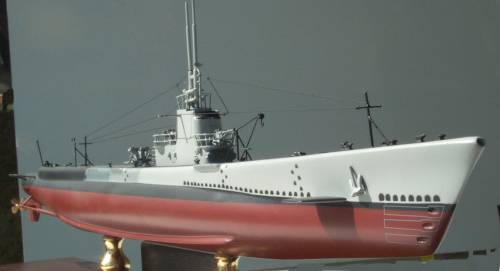
Above is a fleet boat out of the water. Notice the black stripe. That is the waterline. Below that is underwater. While in the submarine one is underwater all the time. The three vertical holes forward are the torpedo muzzles. The long flat piece near the bottom is a roll chalk. It helps to stabilize the round bottom vessel while at sea from rolling. It still rolls like a pig in mud though.
Peace out,
G. M. Goodwin
30 April 2018
 Playing Fair and Being Kind
Of all the tens of thousands of people I have met in my life, you are the only submarine sailor I know!! I always enjoy your stories from those times. This one is no exception. Thanks.
In my estimation your statistic makes you a fortunate individual, Lynne. I’ll do what I can to give you the experience of rubbing elbows with a pig-boat salor.
This belongs here. Take a tour of the Pompanito. Worth the effort.
https://maritime.org/tour/index.php